The Science of How Small Talk Can Add Up to a Big Life
Check out Good Talk to master the art of conversations big and small
Please support the podcast - subscribe on Spotify or iTunes or with a monthly contribution here, or a one-time donation here.
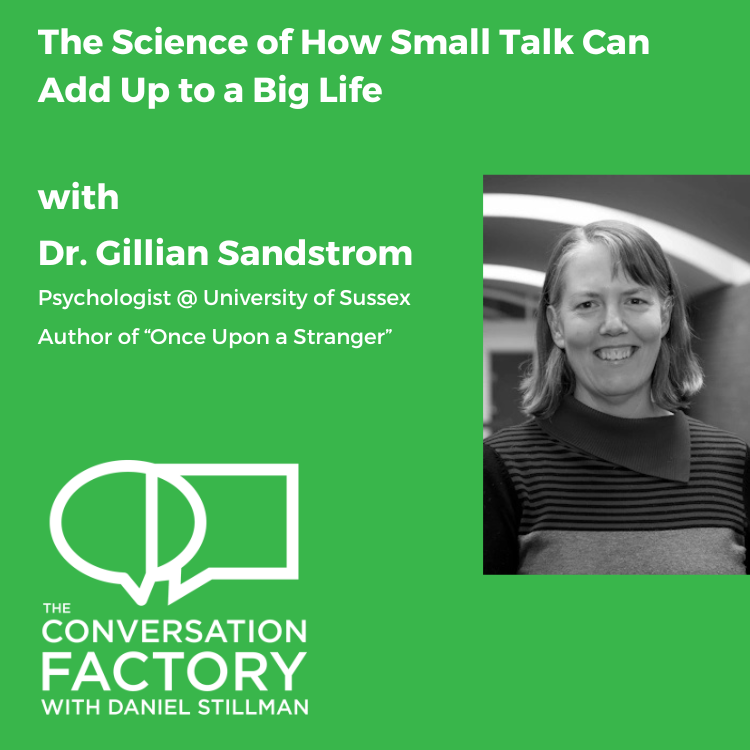
Welcome to the Conversation Factory, conversation designers. My guest today is Dr. Gillian Sandstrom, a psychologist at the University of Sussex who studies what happens when we talk to people we don't know. She is a scientist of Small Talk.
Her book, Once Upon a Stranger, is all about the science of how small talk can add up to a big life.
And I know exactly what you're thinking.
I hate small talk.
I hear this all the time from plenty of senior leaders.
“It's dumb, it's a waste of time!” they say. “Let's just get on with the real stuff. Big Talk!”
The research does not support your aversion.
Your brain is telling you that you dislike small talk because it feels hard. That hardness is the resistance we feel toward any new skill, not evidence that it isn't worth doing.
Small talk is a learnable skill, and it is far better for us than we think. It's like medicine we don't want to take that can heal us tremendously.
Dr. Sandstrom’s data is clear: small talk is a life skill.
My anecdotal data shows that small talk is also a leadership skill.
A leader who says "I hate small talk" is missing out on opportunities to intentionally create connection and community, to learn what's really going on with their team, to build a little psychological safety into every meeting and interaction.
Some of the leaders I coach, and the leaders in the forums I facilitate, have made their peace with this by telling themselves, "Small talk isn't for me, it's for them."
And they're right that it's an act of service, creating a moment of connection for everyone else in the room. But here's what I think they're missing: how much they themselves might come to enjoy it, and how much they will learn from it.
In fact, the ones who’ve been willing to do the experiment, to lean into small talk, have found it has made their professional lives more enjoyable and surprised their spouses to boot.
Now, maybe you're thinking: but Daniel, I'm an introvert.
That's fair. But here's one of the most surprising things in Gillian's research:
Introverts enjoy social interaction just as much as extroverts, and they're just as good at it.
And across the board, these conversations that sometimes we feel resistance to and anxiety about usually go far better than we expect.
And here's the part that surprises people most: even when efficiency feels like the whole point — getting your coffee, getting through the line — taking a moment to actually connect leaves you happier and more connected. And you're still waiting for that coffee either way.
I've seen this efficiency work against leaders in meetings because I find that a meeting that starts cold stays cold, while a meeting where someone takes those first few minutes to actually welcome people in comes alive and leads to better work.
So let's review:
Efficiency is overrated. Creating micro-spacious moments to connect with people is nearly always more enjoyable and beneficial than we think
Even if you're an introvert, you can be good at talking to people AND enjoy it as much as an extrovert
Talking to people is a learnable skill. We reference one of my favorite Pride and Prejudice moments where Mr. Darcy and Elizabeth Bennet discuss how talking to strangers is a learnable skill like playing the pianoforte, not a fixed personality trait.
Gillian has a framework in her book, the acronym QUICK. I refer to it in the interview, but we don't break it down.
How to QUICK-ly break down talking to people into manageable skills and mindsets
QU is for Questions, and her favorite is as simple as "whatcha doing?" You see someone photographing a fence, or fiddling with something in the park — "whatcha doing?" — coming from a place of real curiosity.
I've discovered that in meetings, you can ask almost anything at the beginning to get people talking and to create a moment of spaciousness. One CEO I coached loved asking icebreaker questions. On a day when I was observing the executive leadership team, he asked everyone, "What is your favorite sandwich?"
One amazing thing was that everybody answered the question differently. Each person's answer was a micro-manual to understanding more about that person, because the CTO answered differently than the COO, who answered differently from the CMO. Some people focused on stories. Some people focused on technique. Some people talked about their favorite sandwiches in different cities. It was a portal to understanding the person.
I-C is for In Common. It's why we talk about the weather: it's something we share. You can also point to anything in the environment the two of you happen to occupy — "Did you see those dogs? They are having the best day."
Folks who bristle at the concept of small talk often think that talking about the weather is silly. The truth is, it's okay to talk about the weather and to use that as a bridge to talk about something else. I also think it's one of the reasons why it's great to use your real background in Zoom calls because it gives people something to comment on: the guitar in your background, a painting that you have up there, your plants.
Giving people an opportunity to see the real (and curated!) place you're in gives you an opportunity to talk about something you have in common: you are both peering into a tiny window into each other's houses.
K is for Kindness — a compliment, directions, offering someone a seat, or your company.
And this is certainly a leadership skill that is under-exercised. Using the first few minutes of any meeting to compliment someone on something they did well recently can be incredibly powerful. I think it's an underutilized leadership skill to celebrate wins. Why not take a moment to celebrate some wins while you're waiting for everyone to file into the Zoom room or the conference room?
Underneath all of it is one quiet skill: noticing. Anything can be a portal — a t-shirt, a tattoo, a baby duck. The openings are everywhere. We're just not seeing them.
Which brings me to the real stakes. This podcast episode is indeed about small talk, but small talk is not about small talk. As Dr. Standstrom outlines in our interview, small talk is about creating opportunities for a life well-led.
Once you understand that you can create these tiny moments of connection — in a line, at a counter, in the first five minutes of a meeting — you start to walk through the world a little differently.
So let's talk to a stranger. Here's my conversation with Dr. Gillian Sandstrom.
Video Highlight Links
Talking to Strangers Might Improve Your Mood
Introverts enjoy Small Talk as much as Extroverts
The science of adding small talk to meetings
Small talk creates serendipity - The fundamental ingredient for a big life.
About Gillian
Gillian M. Sandstrom is a Senior Lecturer in Psychology at the University of Sussex. A former computer programmer turned researcher, she specializes in the science of social connection - a surprising path for a self-reported shy child, who found her father's habit of chatting with strangers embarrassing.
That changed during a chance encounter on a Toronto subway, where a conversation about a stranger's cupcake—and a fun fact about riding ostriches—convinced her that talking to strangers was worth the risk.
Today, she combines that lived experience with academic rigor, helping people understand why our fears of connecting don’t line up with the data, a theme she explores in her book, Once Upon a Stranger: The Science of How Small Talk Can Add Up to a Big Life.
Links
Learn more about Gillian's work at https://gilliansandstrom.com/
Gillian's write up in the New York Times
Gillian in the Greater Good in Action Project
Gillian's book "Once Upon a Stranger: The Science of How Small Talk Can Add Up to a Big Life"
Is Efficiency Overrated?: Minimal Social Interactions Lead to Belonging and Positive Affect
Abstract
When we buy our daily cup of coffee, sometimes we engage in a social interaction with the barista, and sometimes we are in a rush. Every day we have opportunities to transform potentially impersonal, instrumental exchanges into genuine social interactions, and the happiness literature suggests that we may reap benefits by doing so; in other words, treating a service provider like we would an acquaintance (i.e., weak tie) might make us happier. In the current study, people who had a social interaction with a barista (i.e., smiled, made eye contact, and had a brief conversation) experienced more positive affect than people who were as efficient as possible. Further, we found initial evidence that these effects were mediated by feelings of belonging. These results suggest that, although people are often reluctant to have a genuine social interaction with a stranger, they are happier when they treat a stranger like a weak tie.
Why do people avoid talking to strangers? A mini meta-analysis of predicted fears and actual experiences talking to a stranger
Abstract
People are often reluctant to talk to strangers, despite the fact that they are happier when they do so. We investigate this apparent paradox, meta-analyzing pre-conversation predictions and post-conversation experiences across seven studies (N = 2304). We examine: fears of not enjoying the conversation, not liking one’s partner, and lacking conversational skills; fears of the partner not enjoying the conversation, not liking oneself, and lacking conversational skills. We examine the relative strength of these fears, and show that the fears are related to talking behavior. We report evidence that people’s fears are overblown. Finally, we report two interventions designed to reduce fears: conversation tips, and the experience of a pleasant conversation. Ultimately, this research shows that conversations go better than expected.
Talking to strangers: A week-long intervention reduces psychological barriers to social connection
Abstract
Although people derive substantial benefit from social connection, they often refrain from talking to strangers because they have pessimistic expectations about how such conversations will go (e.g., they believe they will be rejected or not know what to say). Previous research has attempted but failed to get people to realize that their concerns about talking to strangers are overblown. To reduce people's fears, we developed an intervention in which participants played a week-long scavenger hunt game that involved repeatedly finding, approaching, and talking to strangers. Compared to controls, this minimal, easily replicable treatment made people less pessimistic about the possibility of rejection and more optimistic about their conversational ability—and these benefits persisted for at least a week after the study ended. Daily reports revealed that people's expectations grew more positive and accurate by the day, emphasizing the importance of repeated experience in improving people's attitudes towards talking with strangers.
Books from Dr. Standstrom’s shelf:
https://www.amazon.com/Talk-Science-Conversation-Being-Ourselves/dp/B0D47VL32B
Key Moments
02:45 — The ducklings that changed a stranger's life. Gillian's "cute, aren't they?" to a German tourist by a London pond — and the email two years later thanking her for changing his life.
09:18 — You're not bad at it, you're out of practice. Via Mr. Darcy and Elizabeth Bennet: talking to strangers is a learnable skill like playing piano, not a fixed personality trait.
14:16 — Nobody knows how to end a conversation (so we lie). Conversations almost never end exactly when both people want — and the most common exit is a little white lie, though being the one to close it might be an act of kindness.
17:47 — We pull the ripcord too soon. The "keep talking" research: we predict conversations will get more awkward the longer they run, but they actually get deeper — we just have to sit past the discomfort.
20:30 — Pleasure, purpose… and a rich life. Gillian's three paths to a life well-lived, and why talking to strangers is one of the few things that ticks all three boxes.
22:51 — "Nobody ever asks me that." The phone-only doctor and the cathedral volunteer — small moments of being truly seen, and why a real "how are you?" lands harder than we expect.
28:15 — Small talk is a leadership skill. Daniel's core argument: the first five minutes of a meeting are the work, not the warm-up — welcoming people in versus "knuckles cracking, let's get down to business."
33:40 — Anything can be a portal (the art of noticing). From a sandwich on a park bench to a guitar in your Zoom background — the real skill isn't charisma, it's noticing the openings already around you.
42:18 — Shy ≠ introvert (and introverts are just as good at this). The distinction that reframes the whole topic: introversion is how much contact you crave, shyness is anxiety in the moment — and introverts enjoy these conversations as much as extroverts.
47:47 — Turn it into a game: practice makes progress. The scavenger-hunt study where daily, low-stakes "find someone wearing a hat" prompts melted people's fear of rejection — and the change stuck a week later.
54:24 — It doesn't have to go anywhere. Permission to chat and just walk away, no strings — and the paradox that the good stuff (free zucchini, a surprise collaboration) tends to arrive when you're not chasing it.
Transcript
Daniel Stillman (00:00)
here we are. We're live. Okay. Gillian I really appreciate you making the time for this conversation. And I appreciate that this is, that we're maybe poking at some of the edges of the science of small talk and where it applies and maybe where the science doesn't apply, but maybe where we can try to adapt some of the learnings to it.
Gillian (00:19)
Yeah, well,
we'll have a nice conversation. I'm curious to hear how you think about it.
Daniel Stillman (00:24)
Yeah,
we I mean, I feel like we just got to it's such a cute it's such a sweet book. And it's a we both do it. Yes, it's a very it's a very friendly book. And it's about friendliness in one way. And I mean, this the subtitle of how the science of small talk can add up to a big life is a it's a it's provocative claim. And and I think you've got the research you said, right, and you've got the research to back it up and and
Gillian (00:27)
yeah. Thank you. Yeah, shall we both do it? Yeah.
Yes, I stand by it.
It says can, not will.
Daniel Stillman (00:53)
So, mean, fair.
This is so good, but there's no asterisks. There's no asterisks on it, which is great. So, I mean, the reason I reached out to you, and I'm really grateful again that you were able to make the time to do this, because I know that clearly you don't write a book about this stuff unless you care a lot about it and are excited to talk a lot about it for a long time. here we are. The reason I was thinking about this is that I was doing a session
Gillian (01:06)
Pleasure. Thank you for the opportunity.
Daniel Stillman (01:21)
a few months ago, where we were talking about relationships and communication. And this is these are things that I care a lot about. And one of the senior leaders in this organization was like, I hate small talk. And it's this very common vibe that it's like, it's dumb, it's a waste of time. And let's just get on with things. And I do want to talk about that because like,
Gillian (01:37)
Yeah.
Daniel Stillman (01:45)
I think small talk can exist in lots of places and contexts. And I think it can be with new people, total strangers, folks at a party. think we can also have small talk with people we know or kind of know or people we're just about to meet in a professional context. So I feel like it's in the it's all in this large blob of like, how do we start a conversation and
Gillian (02:01)
Yeah, yeah,
Yes.
Yeah.
Daniel Stillman (02:11)
and why is
it worth starting our conversation? that is a long preamble. I feel like we should get to the heart of the matter. And I want to talk about baby ducks. Because at the end of your right, towards the end of your book. Yeah, sorry, go ahead. What is that?
Gillian (02:15)
Hmph.
Okay.
No, it's just, it makes me cry every time. So I might just cry, but we'll see.
Daniel Stillman (02:29)
I'm so-
that well, because I want to start close in. And, you know, 2022. You're at the Duck Island cottage in St. James Park. This is in, I know, very aptly named. This is in London. And I and I love the opening of the the the letter. mean, I kind of want you to tell the story a little bit. But this opening of cute aren't they?
Gillian (02:39)
Great name.
Yes.
Daniel Stillman (02:55)
And I feel like there's so much in that opening. It's really extraordinary. I think it's a really interesting portal to this topic of what it means to talk to strangers and how we even do it and why it matters. So with that, I should I kind of want to open the floor to you to sort of situate us.
Gillian (03:14)
I love that this is
where you're starting. That's amazing. It was a very meaningful thing for me. So it's interesting to see that that's resonated with you as well. I'm going to forget the details, I'm going to forget the dates. So at some point in time in the past, I was attending a conference. So I don't live in London. I come in on the train. It's about an hour, hour and a quarter, something like that.
Daniel Stillman (03:23)
Yeah.
Gillian (03:39)
and I was able to walk from the train station to this conference. I could take the tube, you know, that would be the most efficient thing to do, but it was a lovely spring day. And so I decided to walk through the park and enjoy the spring flowers. And then at the end of the day, I did the same thing in reverse. I'm walking through the park to go catch my train. And it probably helps that there was no specific time for the train. You they run quite often, so I didn't have any particular time. I could just take my time and enjoy the park.
And so yeah, I passed this spot and there was these cute little fuzzy ducklings, toddling around. Who doesn't like those? But I saw this young man, younger than me man, also looking at the ducklings. And so yeah, I said something like, cute, aren't they? And you never know how a stranger is gonna respond, right? Generally speaking,
I find that most people are more receptive than you think, but often there's this moment of awkwardness where they figure out who are you and what is happening right now. And usually you get to a point where they think, where they realize that you're just being friendly and then everything's fine. So in this case, he seemed very interested in talking. It turned out he was a German tourist traveling on his own. of, this was just after COVID and it was his first time traveling on his own.
Daniel Stillman (04:39)
Yeah.
Gillian (04:54)
And so we just started chatting and it was about a 15, 20 minute walk from there to the train. And he just kept walking with me, ended up walking with me the whole way. And he started reflecting on how he'd been traveling on his own and he hadn't really talked to anybody for a while. And so I think that was part of maybe why he was keen to keep talking to me. I don't remember the conversation. I mean, I remember the...
Daniel Stillman (05:09)
Hmm.
Gillian (05:20)
that the conversation happened because as I say in the book, a couple of years later, I was kind of going on the same walk and I remembered having this conversation with this young man. But I don't remember what we talked about, but apparently he must have asked what I was doing in London. And I told him, you know, I do this research, I'm talking to strangers and how, you know, so many people are nervous about it, but it goes.
you know, it usually goes way better than we think. And we're, you know, we're just too much in our own heads and we worry way too much, essentially. So fast forward. Like I said, a couple of years later, I went on almost exactly the same walk. I was with my husband at the time and I had this, you know, little moment where I was thinking back to the ducklings and the young man. And then a short time later, like about a few weeks later, I got this email and it started off,
it basically it turns out that it was from this young man. And he had happened to come across an article that I had written that has my picture in it. And somehow remember that that was who he had talked to in the park. And I started reading this email and it was a bit generic at first. He talked about how he had...
Daniel Stillman (06:15)
Hmm.
Mmm.
Gillian (06:28)
met new people by talking to strangers. And now all his friends were starting to ask, you know, say that he was so good at it and how had he learned it. And then the line that really hit me where he says, you know, I tell them the same story about this time I was walking in the park and there were these cute little ducklings. And I read that and my heart just started pounding like, my God, it's that guy. And it was just, yeah, he just went on to say how, how it
Daniel Stillman (06:35)
Hmm.
Gillian (06:55)
He really took it to heart and it changed his way of looking at things and he started talking to people more and he just really wanted to thank me for changing his life is how he put it. It was just the most beautiful, like I burst into tears and you know, still I'll dig out that email every once in a while and every single time, even when I was writing about that email in the book with his permission, I was crying.
Daniel Stillman (06:57)
Hmm.
Yeah.
Yeah.
Gillian (07:23)
So it's just really touching.
Daniel Stillman (07:26)
It's such a beautiful story because it's it's almost like the the infinite recursive loop of paying it forward like you were practicing this thing that is a value of yours, which is to talk to strangers because you believe that it's important. And the evidence shows you that it's important. And it created an experience for him that was surprising. And it became something that he got better at and it
transformed his life to the point where his friends commented on it, which is rare. I think there needs to be like a big amount of change. And it highlights something else interesting that I wanted to point out. It's kind of, in a way, one of my favorite scenes from Pride and Prejudice, where Mr. Darcy complains that he doesn't have the fluency of talking to strangers. And Elizabeth is like, you know, you're a man in the world, you're a gentleman of means and an education and like
Gillian (07:54)
It's insane.
Daniel Stillman (08:19)
Why on earth can you not talk to people you don't know? And she's like, I'm not as as good at playing this piano as I'd like to be, but I assume that that's on me for not practicing. And so I think there's this idea that like some people are good at it and some people aren't. And we have the research that we can talk about. We can also talk about how some people think they're introverts and some people think they're extroverts. And so they're they should or shouldn't do it because of who they are. But it's
Gillian (08:31)
Mmm.
Yeah. Yeah.
Mm.
Daniel Stillman (08:47)
But I think your research shows that everyone enjoys small talk more than they expect to and that there's lots of positive benefits. So I feel like we should just give people the like, here's the medicine that you should take. Here's the science that shows like why you should, you know, take X number of steps a day or like drink more water, even though you hate water. And there's people who are like, I hate water. And I'm like, who these people who hate water? But
Gillian (08:56)
Yeah.
Here's where we're getting to, yeah.
You know what I think though,
Daniel, I think it's interesting because I agree. Like I think, you know, we're all, we all know that we should drink more water. We should go to the gym or we should, you know, get eight hours of sleep or whatever it is. We know we should do those things and yet we don't want to as often, right? And so it makes, it makes change difficult because we have, you know, to some extent we have this intention, you know, yes, this is something I should do, but we don't want to.
Daniel Stillman (09:24)
Yes.
Yeah.
Hmm.
Gillian (09:42)
And I actually don't think it's the same tension when it comes to telling, suggesting to people that they might benefit from talking to strangers, at least some people. I think a lot of people, you we have this fundamental need to belong and to connect and be seen and valued by other humans. I think a lot of people know that it would be a good thing to do it. They just feel like they don't know how, or they don't.
Daniel Stillman (09:52)
Mm.
Mm-hmm.
Mm-hmm.
Gillian (10:06)
They're not allowed, they need permission. So I think it's an easier change than some of those other ones. think, yeah, I don't know. That's just my sense based on what I'm seeing. I teach at a university, so I'm teaching young people. I teach this class called Social Connection and Disconnection, and I wanted to teach that so that we could talk about loneliness and normalize.
Daniel Stillman (10:07)
Hmm.
Yeah.
Mm-hmm.
Gillian (10:28)
So
they know that they're not the only person who feels alone and feels like they don't have the friends that they'd like to have, all this kind of stuff. But as part of that class, I get them to talk to a stranger. I give them these little homework assignments. That's one of them. And when I started teaching it, I thought there's no way they're going to do it. They're all going to just opt out. And so I went out of my way to give them other options that they could do instead. But they do it. And they come back and they tell me that they enjoyed it.
Daniel Stillman (10:39)
Yeah.
Mm-hmm.
Mmm.
Gillian (10:54)
So, you know, even that group, which we might think is especially, you know, lacks practice in developing those skills, surprised me every time by their willingness and enjoyment when they do it.
Daniel Stillman (11:03)
Mm-hmm.
Yeah, yeah. It's a really interesting question because I think some people, this is tough because like in a way the people who are taking your class are maybe more inclined to solve this problem than the average person on the street is like, yeah.
Gillian (11:22)
Maybe just solve it, yeah. But I think I often
get like the students who are on the lonely side or on the introverted side who, yeah, who you think might struggle more, but you're right, they might be more motivated to do something.
Daniel Stillman (11:28)
Yeah.
But there's research that I've read that says that most people think that if they spend time alone on a commute versus talking to a random person on the train, that they're going to have a better experience. And then when you invite them to talk to a random stranger, they always have a better experience. And I feel like there's another piece of research that I've been quoting for years, and I don't know where I got it from, but that there's like
Gillian (11:44)
Mm.
Yeah.
Daniel Stillman (12:01)
Most people are afraid they don't know when the conversation is going to end in general, like in general with conversations. I think there's a fear people have that they'll open a conversation and they won't know how to exit it. so how do you as right there, you're like, well, I got a live one. How do I, how do I close this out? So yeah, in a way, like you have your, your model for how to open the conversation with questions and how to find things in common.
Gillian (12:14)
Yeah, I think that's the hardest part.
Daniel Stillman (12:31)
how to bring kindness into the conversation. But I wonder what your, if we're looking at the whole arc of a conversation to maybe help people who are nervous about starting something that's just gonna, they'll never get out of it, which is absurd. It's like, well, we're married now, we can't stop the conversation. What does the research show or what's your experience or your thinking around the overall arc of?
a small talk interaction.
Gillian (13:03)
Yeah. So I'll start with the bad news, which is that there is some research that's looked at whether conversations end at the time, like how often conversations end at the time that both parties would like them to end. And it's something like
Daniel Stillman (13:14)
Yeah.
Gillian (13:20)
3 % of the time, that's the time that they end. So I think it's just a really difficult thing to know when someone else wants to end a conversation, right? So we're kind of trying to guess what other people think and we're not, we're never very good at that. So I guess that's depressing on the one hand, but also on the other hand, it's just saying, look, it is hard. It's not just you, it's just a hard thing to do. So like, that's okay, don't stress about it. But I think
Daniel Stillman (13:29)
Yeah.
Gillian (13:46)
I don't know. So I've run some how to talk to strangers workshops and I mostly, I feel like my role is to facilitate. I'm not teaching people stuff as much as like getting them to talk to each other and come up with strategies. And I think it helps people to sort of pre-think like what if the worst case happened? Like what if I feel like they're hitting on me or what if I don't feel safe or whatever. So just think about.
Daniel Stillman (13:58)
Hmm.
Yeah.
Gillian (14:12)
what your biggest worry is and think about what you could do if that happened, which it almost, you never does, but it helps, you know, feel a bit more confident, I think, if you can go into it thinking, okay, I know what I would do if that happened. So one of the things I ask them is like, how do you end a conversation? And I'll tell you, the number one thing that people do is lie.
So we say, I have to make a phone call or I have to, you know, I'm going to go get something to eat or I'm going to go to the bathroom or so we it's like one of those little white lies that we tell to try to save someone else's feelings essentially is where that's coming from. Right. So I don't have a major problem with that. If people are OK with with doing that, that's what makes you comfortable. Go for it. But there's always one person.
Daniel Stillman (14:38)
Mm-hmm.
Yeah.
Yeah.
Gillian (15:00)
at these workshops who's like, just uses the direct approach. And everyone else kind of looks at them as like, you can do that? And they just say, thank you. I really enjoyed the conversation and it's time for me to go now. That's it. And honestly, that's helped me. I've been trying to do that more. So to realize like,
Daniel Stillman (15:05)
Mmm.
Hmm.
Gillian (15:22)
Maybe, like I even have the thought, maybe it's an act of kindness to be the one who's willing to end the conversation. You you're both trying to figure out, it now? Should I wait? Should I go? So maybe the person who makes that decision is actually doing something kind and helpful. But it doesn't have to be complicated. I think it's, you know, one of those things where, again, we just get in our own heads and make things a bit more complicated than they need to be.
Daniel Stillman (15:23)
Hmm.
Yeah.
Yeah.
Yeah, wow.
Yeah, it's so interesting because in a way, Julian, I feel like the argument that I have in my head of the people I've talked to who are sort of like anti small talk is that like, well, I want to talk about real stuff. And then there's this anxiety that creeps in when the conversations may be gone on too long. There's an opportunity to actually keep it going and to double down and to unpeel another layer. And I wonder sometimes if we pull the rip cord.
Gillian (16:03)
Yeah.
Yeah.
Daniel Stillman (16:16)
a little too quickly when there's something else on the other side.
Gillian (16:16)
too soon. Yeah. Yeah, we feel a little bit of discomfort. And if we kept
going, we might get somewhere better. Yeah. Yeah. I have that sense too. No, but there is research on on there was a study where people were asked to talk to a stranger for a really long time. And and the study is called like, keep talking. And so the idea was
Daniel Stillman (16:24)
Yeah, I mean, there's no research for this, but like.
Hmm.
Gillian (16:41)
maybe it just gets worse and worse. What do people think is going to happen if the conversation carries on? So people made some predictions, then they talked for five minutes or something, and then they reported back on how it had gone. Did they have stuff to talk about? Were they enjoying it? And then they were told, okay, you're going to talk for 20 more minutes. I'm probably getting the numbers wrong. I'm terrible at remembering numbers, but it was a substantial amount of time. And then they were asked,
Daniel Stillman (16:45)
Mm-hmm.
Hmm.
Yeah.
Gillian (17:05)
What do you think is going happen five minutes from now? Will you still have things to talk about? Will you still be enjoying it? What about five minutes after that and keep going? And then they would talk for a bit, pause, answer some questions. How did those five minutes go? OK, keep going. So it's like a little bit at a time. And people thought they'd have less and less to talk about and they would enjoy it less and less. It just didn't happen. We find things to talk about. And the more you talk, the deeper you can
Daniel Stillman (17:11)
Mm-hmm.
Mm-hmm. Yeah.
We do. We do.
Gillian (17:33)
the more comfortable you feel going a little bit deeper or you try out different topics and you maybe have to try a few to figure out what it is that the two of you are going to really connect on, right? If you don't know someone, I think that's why it's scary, right? It's uncertain. You don't know this person, you don't know what to talk about, where's your connection to them. That's also what makes it exciting.
Daniel Stillman (17:37)
Yes.
Mm-hmm.
Yeah. Yes.
Gillian (17:59)
stimulating, right? So if we can reframe it and think about like, okay, of course, we don't know, we're gonna have to find our way and we just have to be patient while we, while we do that and trust that we'll get there.
Daniel Stillman (18:00)
Yes, I agree. Yes.
So for the people who are resistant.
in there, you know, they feel the fear of the hesitation, the resistance. What do you feel like that? And we and we all do. Right. And in a way, maybe there's this expectation that we all are resistant to it. And so nobody likes it. But what is I mean, what do you say to people? What is your research shown about how people actually like it and benefit from it? Like, if this is a bottle of pills, and we should take it like, what would it say? I'm not not the warning like the like
Gillian (18:17)
We all do, like most people do. So I wanted to normalize that, right? Yeah.
Mm.
You
Daniel Stillman (18:43)
But the like, warning, this may make your life absolutely better. Like how does it add up to a big life? Because it clearly does.
Gillian (18:49)
Yeah, I think so. I guess one way I've been thinking about this lately is in terms of what does a life well lived look like? You might be thinking, where is she going with this? But for a long time, we've thought, you know, maybe that's a life of pleasure, right? A life full of enjoyable things. That's one way to live a good life or a life full of purpose and meaning. Right. That's another way.
You can do both. And more recently, researchers think that there's actually a third pathway, which is a rich life. So a life full of diverse experiences and interesting things, right? And sometimes that doesn't feel as pleasurable. It can be more unstable. But it has value also to have that richness. And I think talking to strangers,
ticks all three of those boxes. So there's research on, you know, in terms of pleasure, there's research in terms of how talking to strangers tends to put us in a good mood. And, you know, we think it's not going to, but it does and far more than you think it will. In terms of richness, you know, there's research about how we tend to learn more from talking to strangers than we expect to. We just talked about how it brings in this kind of novelty and
Daniel Stillman (19:45)
Hmm.
Gillian (20:01)
you you don't know what's going to happen and that's kind of exciting. So it adds this richness, you know, I've had so many amazing conversations where I've learned new things or, you know, different perspectives that I hadn't encountered before. And then finally, in terms of meaning, I just, are not, losing our connection to our fellow humans. You know, it's so easy now.
Daniel Stillman (20:23)
Hmm, yeah.
Gillian (20:25)
to just not even notice that there's a human around you. It's just like, that's just the piece of furniture that provides my coffee at the coffee shop. Like we don't even see the person anymore, right? I've had so many people doing this research and the research came from me starting talking to strangers and getting kind of hooked on it. And so the two things kind of feed into each other. But the more I've gone along, the more...
Daniel Stillman (20:38)
Mm-hmm.
Gillian (20:53)
I want to have those human moments where I show people, I see you. I'm acknowledging that you are a human and I am a human. And the more I've done that, the more times I've asked, just literally just ask someone, how are you doing? And doing that in a way where they can tell that I really mean it, right? It's not just a throw away, I'm like really asking them. And so many people said, nobody ever asked me that. So I'm thinking like,
Daniel Stillman (20:57)
Hmm.
Hmm.
Gillian (21:20)
during COVID, a doctor's appointment over the phone. so I'm thinking, that's a human who's talking to people every seven minutes and doesn't get to see them. And what must that be like for them? And I said, how are you doing? This is a really weird kind of thing that you're doing now. And they're like, nobody ever asked me that. Or I tell a story about going to visit a cathedral here in England. And there's a man who's a volunteer who's
Daniel Stillman (21:38)
Mm-hmm.
Gillian (21:50)
whose job is to just make sure people know where to go and sort of, you know, maintain the orderly fashion. And I said, how are you doing? He's like, no, that's my job. Like nobody ever asked me that. I do that all day, but nobody sees me essentially is what I heard. So I just, I just think there's something so meaningful. It feels like a really powerful thing that each of us can do to just look someone in the eye and say hello and see them as a fellow human. So in that sense, it feels like
Daniel Stillman (22:03)
Mm. Mm.
Gillian (22:20)
a really meaningful thing to do as well.
Daniel Stillman (22:22)
Yeah, I really appreciate this. And when I when I think about this, this quick acronym, this last piece of kindness, it seems like it's an opportunity to create a safe space, a little opening to slow down and to be more human. And I feel like when I was reading about you talking about your your dad, there's like this willingness to I don't want to say put on a show, but like
Gillian (22:27)
Mm.
Daniel Stillman (22:48)
turn it up, turn a part of ourselves up a little bit. Say like, I'm just gonna be a little bit nicer to this person. I'm gonna slow things down a little bit more. From my perspective of like, I'm designing this conversation, what am I designing? Like, well, I'm maybe slowing the pace down. I'm gonna notice something that's going on in their lives. I'm gonna create the space for this interaction that is a little bit more human as opposed to just like getting on.
Gillian (23:02)
Mm.
Daniel Stillman (23:15)
with life.
Gillian (23:15)
Yeah,
yeah. And I think one of the first papers I wrote kind of acknowledged that it can feel sometimes that people might sort of worry about this is not efficient. You know, we want to get down to the good stuff. We don't have any time for this, you know, talking stuff. And I just think that's that that it yeah, it does. I don't think it works that way in practice. I can see how it might feel that way. But I think
Daniel Stillman (23:27)
Mm-hmm.
Yeah.
Gillian (23:41)
you know, thought experiment. And we've probably all been in this situation, but let's say you're standing in a line and it's a really long line and it's moving really slowly. And you're like, I just want to get back to work. I have a, you know, three mile long to do list. and I'm stuck in this stupid line waiting for my lunch and you start getting frustrated and anxious and stressed. And guess what? If you turn to the person standing next to you in line and you had a little chat with them, like,
It's not going to make the, it's, you know, it doesn't affect how long you're going to be standing in the line, but it does affect your perception of how long you're standing in that line. That line is not going to feel as long, right? And you're not going to feel as stressed and it's going to change everything to just have that little chat. So I think, I think there's a lot of cases where it doesn't take any longer. but it, makes everything more smooth, right?
Daniel Stillman (24:20)
Yes.
Yeah.
Yeah.
Yes, socially smooth. There's a smoothing out, it's creating a social experience. And this is where I think the science of small talk as you studied it can relate to the broader business context. Here's my pitch. So from what I understand about your research and your writing, a lot of small talk happens in, we're on vacation where we've got spaciousness.
Gillian (24:35)
Yeah.
Hmm.
You
Yes. Yeah.
Daniel Stillman (25:01)
The spaciousness is built in. We are
not supposed to be anywhere. And so we're we've intentionally created the space. OK, I'll sidebar. Some people do not know how to do that on vacation and still cram way too much stuff in their vacations, but they're still they're walking more places. This is clearly something you do as well. Like I'm going to walk someplace instead of take the tube. But even with the tube or the subway, there's a period of time where nothing can happen.
Gillian (25:09)
Mm.
Hahaha
Yeah.
Yes. And I think some people get like the shakes, like I need to be doing something.
Daniel Stillman (25:31)
We're just here and I've. Totally.
And most of us are not, as they say, raw dogging these things. We are podcasted up. We have books. If we're doing it digitally, there's really no interface that allows someone to sort of like connect with us around like, I see you're reading a book about talking to strangers. What's that about? But there's these there's these moments between things where we can turn them into a real experience like a waiting on line. I feel like.
Gillian (25:41)
Yes.
Hmm.
Daniel Stillman (25:59)
Small talk is clearly a life skill, but I would also say it's a leadership skill because every day teams are having massive amounts of meetings. And I know that every meeting when it starts does not have everyone there. And I know that it takes time even certainly physically, but definitely digitally to kind of like get everyone digitally in the room, but extra time.
Gillian (26:25)
and settled,
yeah.
Daniel Stillman (26:26)
to get everyone
settled and focused. And I found that it is a leadership skill to take those five minutes at the beginning of a meeting and welcome people in to orient them to say hello, to talk about whatever, but in a way that really gets people enlivened and connected. And I think some people know how to do that in a normal human way.
Gillian (26:33)
Hmm.
Daniel Stillman (26:53)
And some people don't, where it's like, all right, knuckles cracking, let's get down to business. I think it's a leadership skill to create those human moments when it seems like all we have to do is go, go, go. And that's where I think there's a lot of potential overlap.
Gillian (27:11)
I
love that, yeah. And I wonder with the leaders who don't do that, how much is, like part of it could be just thinking that there's no value in it or not being aware that there might be value in it. But also some leaders might just be anxious about it, might feel like they don't know how to do it or that it would be inappropriate or, you know, like there's fears going on with all of us, so.
Daniel Stillman (27:30)
so…
Yes. So I'm wondering how you can think about the research you do have around how to open to conversations and finding things in common and creating kindness. Where do you feel like it? There are safer overlaps to make the claim or what types of questions, what types of conversational moves do you feel like are applicable in a professional context where maybe we know each other a little bit? Maybe some of the people know each other.
Gillian (27:39)
Yeah.
Hmm.
Daniel Stillman (28:06)
Maybe we're all meeting here for the first time. Maybe we all know each other, but we still have this opportunity to create a space for a more human interaction.
Gillian (28:16)
Yeah, I think, I mean, I think it starts with the willingness to do that. And I feel like that could be a challenge too. And I'm going to pivot to talking about education because that's something, it's a workplace of sorts. You know, and I'm aware of research on professors feeling like they don't need to.
Daniel Stillman (28:29)
Mm-hmm.
Gillian (28:38)
pay any attention to that kind of social connection with their students and feel like it's not my job to be friends with my students. And I don't think that's what anybody is saying. Like you should be friends with your students, but I think you can be a human with your students, right? And I think that has a directly analogous, a direct analogy to a meeting room, for example. So I think, I think you need to start by, by,
Daniel Stillman (28:59)
Mm-hmm.
Gillian (29:03)
being willing, realizing that having that connection is important and has positive consequences, being willing to do it, not saying like, that's not my job or that's not appropriate for this situation. So I think that's the starting point, right? But exactly what to say? Gosh, I mean, I think it just depends on the situation and yeah, like you said, some various examples, like if you,
Daniel Stillman (29:18)
Hmm.
Gillian (29:29)
know people, it's going to be a bit easier, right? Because you can ask, I don't know, you can just ask what were you doing on the weekend? Or what are you looking forward to? Or I don't know, here it feels like everybody's like, what's your next holiday? Where are you going? Or, you know, so it doesn't even have to be really personal. So if people feel really uncomfortable, and they're like, I want to keep work and family, you know, home life separate.
Daniel Stillman (29:32)
and
Hmm.
Yeah.
Gillian (29:54)
That's fine. Nobody's saying you have to like, bare your deepest, darkest secrets. But yeah, it makes a big difference to be a human with your colleagues or your boss. Because I think, yeah, we want to work, if we're working together, it's just, it's cold if we don't feel like we know the other person a little bit, right? Even just a little.
Daniel Stillman (29:59)
Mm-hmm.
Yeah.
Even just a little. And I and I think creating that space does take work in the same way that it you've gotten bet. Yes, you've clearly gotten better at the skill of opening conversations. Your dad, you talk about your dad, like having these like phrases that he reuses all the time that works. You know, he's he's he's working his material.
Gillian (30:29)
And probably repetition, right? Yeah.
Yeah. He's like workshopped them. Yeah.
Daniel Stillman (30:47)
He's workshopped his material over years and
Gillian (30:49)
Yeah.
Daniel Stillman (30:50)
has found the openers, the questions that kind of get people to respond. Right. I and.
Gillian (30:56)
Yeah. And I think
I rely a lot on my observation skills. And I think that's something I have in common with my dad. But I was asked once by a journalist to do a thing where we go to the park and I had to approach someone and have a chat with them. And I thought, great, bring it on. I want to do this and show people how easy it is and how enjoyable it can be. But then
I discovered doing it on demand like that was actually really, really hard because I'm not just going up to random people. I've just gotten really good at finding a way to create an opening with more and more people as time has gone on. And most of the time that comes from observation. It comes from seeing something that they're wearing and making a comment on it or bringing their attention to something.
Daniel Stillman (31:23)
Hmm.
Mm-hmm.
Mm-hmm.
Mm-hmm.
Gillian (31:46)
But I have to have something, like I have to have some reason to start the conversation. I mean, you can just say hi as you pass, it's, find it difficult to start without having something that I'm gonna say. And I think probably the skill that I've learned the most is figuring out more and more ways to get started.
Daniel Stillman (31:50)
Mm-hmm.
Yeah, and this is why I started with the like, cute aren't they ducks comment because in a way I feel like the it's such an innocent and simple phrase. It's totally unobjectionable. Ducks are baby ducks.
Gillian (32:07)
you
They are
objectively cute.
Daniel Stillman (32:19)
Baby ducks. Guys, if you're listening to this in audio, you can visualize the baby duck
and we know that they're cute. We can. We're allowed to objectify baby ducks, right? They're objectively cute. And before we started recording, you're like, we're on video. I wore this T-shirt as a conversation starter because it's got a moon and we can talk about being outdoors and I can see your background. Like I can talk about your plants. I think there's a benefit to having video on in.
Gillian (32:41)
Yes.
Mm.
Daniel Stillman (32:46)
mean, obviously it's nice to have an actual phone conversation with someone so you can just focus on their voice. But in this context, I can be like, oh, wow, Gillian's got a greenish thumb. The money plant seems to be doing OK. I'm like, what is that buffalo? It's not. It's a fake. Right. So now we can talk to like any object I think can create a portal. And I can certainly like wonder what that fluffy object is in the air. It's like it looks like a bison. I'm not even sure, Oh, it's a it's a highland coup.
Gillian (32:56)
It's not real.
Yes.
It's it's a Scottish cow. Yeah, a Highland cow.
Yeah. I know. Super cute. My husband bought it for me. It's like maybe the best gift he's ever given me.
Daniel Stillman (33:16)
my God, those are cute animals. Those are super cute animals as well.
That's amazing.
So I feel like people don't realize that like anything can be a portal to talking to anyone about anything. And this is where I think it is definitely a life skill to be able to talk to anyone. I know you said that this is like, it's very hard to turn it on, but like it is, I would say like you could.
Gillian (33:38)
Absolutely.
I eventually ended
up sitting next to someone on a bench and asking her about her sandwich. That's what I ended up doing on that occasion. That's all I could come up with, but I came up with something.
Daniel Stillman (33:47)
Right.
Hey, mean, that's Sandwiches,
I think are a there's a world in a grain of sand there. Like I could talk about sandwiches for days. But we for anybody who goes to parties or gatherings or wants to have a bigger life, as you're saying, a richer life, the practicing intentionally opening a conversation and talking to anyone about anything, any time, anywhere is like doing a repetition of a.
If we're talking about like physical therapy where you you stand, you do a wall sit, you're not doing a wall sit to do a wall sit. You're doing a wall sit so that you can have stronger back, stronger quads so that you can walk, jump and live. And it sounds like talking to people is like practicing the fundamental skill that it is the human skill, talking to people.
Gillian (34:36)
Yeah.
And I like the analogy because one wall sit is going to be hard, right? I don't know. I don't like wall sits. I find them hard work. I mean, they're fine for the first few seconds. You're like, yeah, I got this. And then you're like, my God. And you have to do it a bunch of times, right? And it gets easier. I mean, it's just like any skill. So yeah, I'm an introvert. I used to be really, really shy. And you know, you probably remember the story I told in the book about how I had a
Daniel Stillman (34:44)
No.
Sure.
Yes.
Gillian (35:03)
luggage removed from a plane because they called my name and asked me to push that call button. To be fair, they did not say that that's why they wanted me to push the button because maybe I would have been, but they asked me to identify myself and I just didn't feel like I could do that. I didn't want to push that button because then a scary flight attendant would come over and I'd have to talk to them and I was not okay with that. And now...
Daniel Stillman (35:11)
Mm-hmm.
Yeah.
Yeah.
Gillian (35:28)
I talk to strangers all the time. That doesn't, and I'm not saying that now I'm like a paragon of social skill because I'm not. I still have plenty of awkward moments. I'm, yeah. But talking to strangers has become just incredibly easy over time with practice, you know, learning that most of the time it's really fun. And, and yeah, I think.
Daniel Stillman (35:34)
Hmm.
Hmm.
Hmm.
Gillian (35:53)
I try to be really clear in the book. I've had a few conversations that have been like literally transformative. I've had quite a few conversations that are really fun or really interesting, or I learned something or, know, like there's some, some piece, you know, value that I can point to. Then there's plenty of conversations that are just like the average conversation is average, right? Forgettable, nothing, right?
Daniel Stillman (36:05)
Yeah.
It should be. Statistically speaking,
the average conversation is average.
Gillian (36:20)
Exactly.
And, but I think that they all matter. think even those forgettable ones matter because they add up to me feeling like I can talk to anybody. And that makes me walk through the world differently. Like I really think it has changed my life in that sense that I don't feel nervous about other people anymore. I mean, if I'm down a dark alley, of course, I mean, it's not, you know, but in general,
Daniel Stillman (36:42)
Hmm.
Sure.
Gillian (36:47)
I've talked to so many people and they seem nice. And it just changes how I think about the world. I feel safer, I feel more trusting. I feel just more connected to my fellow humans and more comfortable in the world. And that comes from having a lot of boring conversations or like average conversations, as well as all these really nice ones that
Daniel Stillman (37:08)
And this is from a person who is a self-described introvert.
Gillian (37:13)
Yes, absolutely. I will be ending our call going downstairs getting a cup of tea sitting on the couch with my cat and a book. That's my idea of the perfect evening.
Daniel Stillman (37:21)
Yes. Yeah, I mean,
it depends on the cat, really, but when my wife and I travel, she wants all the cats to be her friends. And the sad truth is that most cats don't want to be your friends unless you have enough fish heads to feed them all, which is rare, only happens in Greece. So I want to unpack this because I think and this is a dangerous topic because I think some people
Gillian (37:27)
Yes.
you
Yeah, me too. They don't want that. I know.
Daniel Stillman (37:50)
where the identity of introvert as in a way that limits what they can do in the world or what they think they should have to do or what they are capable of doing and it and as a bubble like and and I feel like everyone's on a spectrum. think probably true extroverts are psychotic and true introverts.
are like, maybe also psychotic, I don't know, where it's like, I don't like to talk to anybody at all. But most introverts say like, well, I feel more comfortable talking to my friends. But at some point, a stranger became a friend. And so I want can I want I'm wondering if you can just ground us in the reality of what you understand is the science of this very clumsy phraseology of like, I'm an introvert, I'm an extrovert, therefore blank versus the like,
Gillian (38:30)
Yes.
Yeah.
Daniel Stillman (38:45)
I have many ways I can be. There are many ways to show up in the world. Some of them are harder, some of them are more useful, and I can learn to be more ways in ways that are beneficial to me. That's what I'm not to put words in your mouth, but that's kind of the sense of what I'm getting from your experience, your life experience.
Gillian (38:57)
Yeah. Yeah.
Yeah, from and yeah, so there's so many places to start to try and address that. And I want to be sensitive because because there are people who have clinical social anxiety. And, you know, maybe what we're saying here is not at least not at this point without some really hard work, a possibility for a very small number of people, right, like a minority of people. But yeah, I do agree that there's probably
a much larger number of people who are identifying as introverts and possibly using that as a way of avoiding the discomfort of, you know, saying, I can't do this because I'm an introvert, introverts don't do this. So a couple things, you know, in terms of the research on introversion, what we think an introvert, what it means to be an introvert,
is there's two different things. And this is a topic my students love every time I bring it up because introversion is about how much social contact you like and you crave. So introverts want less of it. They don't have that same need to have social interactions. So that's how they differ from extroverts.
shyness is about feeling anxious in this, you know, when you do have an interaction. So they're, they're different. It's about how much you want and how you feel when you have it. There's two different things. You can be a shy introvert. You can be a non shy introvert. and which is like, what? but you can, absolutely.
Daniel Stillman (40:22)
Hmm.
Mm-hmm.
Happy to talk
to a stranger, or you will talk to a stranger, but you yeah.
Gillian (40:39)
Well, and that is what I think I am.
That's absolutely how I think I am now. I'm not shy. I don't get anxious about it for the most part. I think, like, you know, it's not anxious to the extent that it causes me problems. I still get a little nervous and I think we all do and that's okay. And I don't know if I'll ever get rid of that. But I'm, yeah, but I'm definitely still an introvert who doesn't seek out those kind of, you know.
gatherings with lots of people and lots of noise. Like I walked into room today, I play tennis and we have this clubhouse and I opened the door to the clubhouse and it was like a social morning and a whole bunch of people have been playing and now they were inside and they were all drinking coffee. And so I opened the door and this wall of noise comes out and I just kind of shrunk. Like that's my worst nightmare. I hate that.
Daniel Stillman (41:23)
Hmm.
Gillian (41:28)
And there was people I know in there, very nice people that I like a lot, but is still just like physically, was just like, this is not my happy place. But what I do want to say is that introverts enjoy social interactions just as much as extroverts. And as far as research can tell so far, introverts are just as good at it as extroverts. And I find that really reassuring.
Daniel Stillman (41:35)
Mm-hmm.
Gillian (41:52)
So yeah, I would love to tell every introvert out there or every shy person out there, which like I said, may or may not be the same thing. You can do this and it's not. Yeah, you feel uncomfortable now. Most people do. Even people that you can't tell are feeling anxious and nervous, might be feeling anxious and nervous. And it's something that you can.
Daniel Stillman (42:12)
Hmm.
Gillian (42:16)
practice and get better at, but you do have to do it repeatedly to be able to get there. And, you know, I have some research on that with my amazing collaborators, Erica Boothby and Gus Cooney. did this scavenger hunt game. So I'd done a lot of studies where I asked people to predict how it would be to talk to a stranger. Then I'd make them talk to a stranger and report back on how it had gone. And every time, you know, multiple studies,
people would say it went way better than they expected. Like it's a huge effect compared to anything else that we've ever studied. It's a just massive difference between what people think is gonna happen and what actually happens. And so we worry about all these different things and none of them tend to happen. But even after having a very pleasant conversation with a stranger, we don't think the next conversation is gonna be okay. And I think that's because it's difficult.
Daniel Stillman (42:51)
Hmm.
Hmm.
Gillian (43:12)
it's just really difficult to generalize. can say, well, that successful conversation was because of the other person. We give all the credit away. We're like, I just had a nice conversation with Daniel. That's because Daniel's a great conversationalist, which you are, by the way. But if I talk to someone else, I might think, well, that's not Daniel. I don't know this person. What if they're not any good at talking? And so it's easy to think that
Daniel Stillman (43:32)
Hmm.
Gillian (43:36)
one conversation that goes well is just a fluke. And so I was like, I want to fix this. How do I fix this? How do I get people to be a little bit more positive, have more positive expectations? And I thought the solution seems obvious. How we get there is not so obvious. The solution seems to be, I need to get people to have a lot of conversations with strangers because if they do that, surely they can't help but see that there's a pattern.
Daniel Stillman (43:40)
Hmm.
Gillian (44:04)
And it's not just one that goes well, but they all tend to go well. But how am I going to do that when people don't want to have even one conversation, right? And so I came up with the idea of turning it into a game. And so with Erica and Gus, we had people play a talk to strangers scavenger hunt game. So we had people use this app on their phone and every day they had like a menu of choices.
Daniel Stillman (44:04)
Hmm.
Mm-hmm.
Mm-hmm.
Gillian (44:32)
like find someone who's wearing a hat or find someone who's drinking a coffee. So they were supposed to be really, really easy. It they weren't supposed to be hard. The hard part was once you found the person you had to actually talk to them. I think people really appreciated having their options narrowed that way. You know, to someone with a hat, okay, I got this. And it was kind of a game, you know, it was kind of fun. But what we found was over the course of the weeks, we may be asked people to talk to a new person every single day for a week.
Daniel Stillman (44:34)
Mm-hmm.
Mm-hmm.
Hmm
Gillian (45:00)
And gradually, day by day, people were less worried about being rejected and more confident in their social skills. And we followed up with them a week after the study ended and it seemed like those changes had stuck. So that I think is promising is just the idea that practice makes progress. We can learn and get better at that.
Daniel Stillman (45:09)
Yeah.
Hmm. I mean, it's speaking to I hear two things. One is like just a fundamental attribution error, like I'm attributing the this went well or didn't go well to some of the outside versus being intentional about my own practice and being a reflective practitioner and an intentional practitioner. And it sounds like there's also a neuroplasticity element here, which is to say that as as
Gillian (45:35)
Yeah.
Daniel Stillman (45:50)
know, Elizabeth Bennett was telling Mr. Darcy, a piano is an instrument we can get better at playing if we try intentionally, you can't just sit in front of a piano. Right. I mean, I suppose there's a very rare person who can just be like, I'm going to figure it out. But like, most of us need to learn the scales. We need to practice and lean into some discomfort and
Gillian (45:59)
Hmm.
Yes.
Daniel Stillman (46:13)
I mean, I think your book is a very, very handy guide for anybody who's like, I understand that this is a life skill. I understand that this would make a richer life. I understand that I need to be able to talk to more people in order to have a richer life, but it is hard to know where to start. I think one can start. Right. And regardless of whether someone identifies as an introvert or as an extrovert, we can all get.
Gillian (46:28)
Hmm.
Daniel Stillman (46:38)
better at this because honestly, I'll tell you, Julian, I've met some extroverts who are just domineering. And it's actually not fun to be in a conversation with them where they are not reading cues, where they're not stepping up and stepping back. So I don't think that we could just say, as you pointed out, extroverts are somehow better at talking to people. They're just more likely to start. They may not do it well.
Gillian (46:45)
Yes, agreed.
Hmm.
No.
And I
think some of them are anxious too. Like some of that extroverted behavior can be just a manifestation of not feeling comfortable and just feeling like they need to fill the space. So I don't know. It helps me to think, you know, maybe, maybe they're struggling too.
Daniel Stillman (47:15)
Yeah, there's another piece of this. I mean, this is a weird layer and I probably shouldn't even bring this up with four minutes to spare. But I feel like there's something about older men like my dad loves to talk to strangers. But I think there's a way of avoiding it. So it's actually a means of avoiding intimacy in a way. And, you know, because it's like, hey, this is easy and fun. And I made someone laugh and I had a nice interaction. I think there's still a gap on how to get people to go from small talk to.
Gillian (47:34)
Mm.
Daniel Stillman (47:43)
relating to creating friends. I think there's still something else. Yes, there's a gap. But I don't think that's not the fault of your book. I talking about a very specific slice of a very important challenge around social well-being and social. Yeah, this is like the beginning. 100%.
Gillian (47:46)
Hmm, there's a huge gap, yeah.
Ha ha ha!
It's a tiny piece of the puzzle. Yeah. But it's the critical one, right? It's the starting point. So yeah,
I'm not making any claims that this is going to like solve the loneliness epidemic or help you find the love of your life, but you cannot do those things without talking to strangers. it's
Daniel Stillman (48:17)
Correct. Right. This
will get your reps up. With our moments to spare, what haven't I asked you that I should ask you? Is there anything else that we need to include besides where people can find you on the internet, obviously, and they can buy your book wherever?
Gillian (48:22)
Exactly.
You've asked me such interesting
questions and you've avoided some of the obvious ones. So thank you.
Daniel Stillman (48:37)
That's thank you, I guess I mean I suppose there's probably an obvious question that I should have asked you that would make this more helpful to people but I suppose Yeah, what's an obvious question? I should have asked
Gillian (48:47)
well,
now you're to be like, what have I missed? no, you didn't explicitly ask me how do I, know, give me some tips. How do I start the conversation? But you did mention the, you know, the acronym that I've come up with and sort of said it yourself. So, which yeah, the quick acronym. gosh, yeah. I mean, I have been asked that question recently, the one you just kind of touched on, which is like, how do you.
Daniel Stillman (48:54)
Hmm.
Gillian (49:08)
How do you go from this to something a little more, how do you turn this into a friendship? And I guess one of the things I've been thinking about lately is just, I've had that question and also, what do I get from this? And it depends on how you ask that question, right? Like you asked it in terms of like, kind of, tell me about all the wonderful things that can happen is how I interpreted how you asked it. Whereas sometimes when I get the question, it feels like,
Daniel Stillman (49:24)
Hmm.
Gillian (49:35)
convince me, like I need to know that there's gonna be something coming out on the other end. And so I guess I'm starting to think that people, I don't know where I was going with this, Daniel
Daniel Stillman (49:48)
We're gonna leave this in because I think it's great to have little blips in our brains. Well, it's like people do want more out of it. They want to be they want to be told why it's going to work and you need to prove it to them. But like this is about humanity. Yeah, go for it. See, I knew I would I knew I would spark it if I
Gillian (49:51)
Yeah, I'm fine with that.
I know where I was going. I know where I was going.
Thank you for being patient and filling the gap in the meantime. It doesn't need to go anywhere. There doesn't need to be anything that comes from it. Like it's okay to talk to someone and then walk away. So we don't, I think sometimes we feel like, we had a nice chat. We should exchange contact information. We should like, know, well let's get together for, we should, you know, catch up and.
Daniel Stillman (50:08)
Yeah.
Gillian (50:30)
And sometimes we even mean it, but we probably know that that's never gonna happen. We have finite time and energy. And I guess I just wanna say to people, it's okay if you just have a chat and walk away. It's okay to have acquaintances that you have no intention of deepening that relationship and turning it into something else. That is okay. And yeah, like you said, I think often, most of the time, especially with strangers, I'm not...
Daniel Stillman (50:32)
Mm-hmm.
Yes.
Gillian (50:59)
going into it thinking that I'm going to get anything from it. Other than like, you know, maybe a laugh or, you know, a good mood, that kind of thing. feel like, I feel like I've put something positive into the world. So I do expect those things. But sometimes there are instrumental benefits too. You know, like I've had people give me free vegetables. You know, I talked to someone outside their allotment garden and they're like, please take some of my extra zucchini. Or I've,
Daniel Stillman (51:26)
Right.
Gillian (51:28)
you know, in the, in a workplace kind of context, I saw a society newsletter, did a nice profile about someone. I had never met her, but we'd exchanged one strange email before. And I just sent her a message and I said, I saw this profile. It was really nice. Congratulations. And then she said, you know, Hey, thanks for reaching out. I had this project that I was interested in and I wondered if you might want to get involved in it. And so like I didn't.
Daniel Stillman (51:55)
Hmm.
Gillian (51:56)
know that was going to happen, but this really nice thing happened because I reached out just to be a human, right? And so I think there's something really beautiful that can happen in terms of networking, in terms of talking to a colleague, talking to a neighbor. Good things happen even when you're not trying to make them happen. And maybe they're even more likely to happen that way because people like you and want to do things for you.
Daniel Stillman (52:18)
Yeah.
Gillian (52:24)
when they feel that you're authentic and that you're just trying to connect with them on a human level. Thank you for helping me get there.
Daniel Stillman (52:29)
Yeah. Yeah. You're talking about what? No, no, it's it's
really I think it's a really good point. And I had a mentor used to talk about optimizing his life for serendipity. And you could really think about it as creating a greater surface area for life to find you for more interactions to happen. And you do talk about this in your book around having a nose luck, but also having no strings like I don't expect anything to come out of this. And it's OK for nothing to come out of it besides.
Gillian (52:38)
Mmm.
Yeah.
Yeah when I talk about luck.
Mmm. Yeah. Yeah.
Daniel Stillman (52:56)
we had a moment of human kindness and connection, which in today's day and age is not a small thing to create more of that. And so I think it's a really it's well put in it's it's it's a good quote unquote argument for why getting better at this work matters. with that, feel like I want to respect your time. I feel like it's been really great. I appreciate you being open to the serendipity and to unpacking some of these.
Gillian (52:58)
Yeah.
No, agreed.
Daniel Stillman (53:22)
these questions. I hope people read your book and I hope I will. You said I think it would. If everyone read this book and practiced it, I definitely think the world would be a better place. Like there's literally no question. If more people were doing this, that would be good. Fair, fair.
Gillian (53:33)
I'm so glad to hear that. I obviously do, but I'm maybe a bit biased, you know, but it has
been gratifying, like even just talking about the book, like with, you know, with my editor, with people who've been, you know, peripherally involved, you know, even like journalists who've reached out and interviewed me and then later have come back to me and said, you know, it kind of made me notice people a bit more. And I've started, you know, talking to the baristas. So, so it, that, that, that just makes me so happy.
Daniel Stillman (53:50)
Mm-hmm.
Mm-hmm.
Gillian (54:03)
I think we need, yeah, a change in sort of, we just need to be able to look around us a bit more and notice those opportunities. In that scavenger hunt study, that was another thing that changed over time as people started noticing more opportunities for it. And I think there's opportunities around us all the time. We're just not seeing them. So that's a part of the puzzle as well, is noticing that there are opportunities and then just, it's just a little bit. mean, I'm not.
Daniel Stillman (54:03)
Yeah.
Gillian (54:30)
Also not trying to say like, should talk to all the people all the time, like, no. But just a little bit more can make a big difference.
Daniel Stillman (54:38)
Yeah, 100%. Well, that seems like a great place to call scene. I really thank you for your generosity in this conversation.
Gillian (54:47)
Thank you. Thank you. really, um, and I really did enjoy your questions. felt like, yeah, maybe you did. Did you have a list? Were you freestyling a little bit? Cause it didn't feel like very scripted. It felt like you were just kind of like going with the flow and
Daniel Stillman (55:03)
I had six index cards, but no list. And I knew there was plenty of material for us to work.
Gillian (55:09)
Yeah.
Well, when I said at the beginning about how I was a bit nervous about how it relates to the workplace, I think it's because, you know, what the type of interaction that I focus on in the book is the kind of go up to someone you don't know, have a little chat and then walk away and never see them again. Right. And that specific situation doesn't happen very much in the workplace. Like it might with a customer.
Daniel Stillman (55:28)
Mm-hmm.
Mm-hmm.
Gillian (55:38)
or there's a few situations where that happens, but it's not usually that. It's like, you're gonna see them again. And that, think, changes things a lot. It raises the stakes. But I think that the bigger thing, the broader thing is just the being human and being willing to connect. And that does cross all the boundaries.
Daniel Stillman (55:48)
Sure, but yeah, it does.
Yes.
Well, we didn't talk about this and we're definitely, you know, my first degrees in physics and this question of like, how do you create an isolated system where we can study friction, static friction versus dynamic friction and you make it, you know, Galileo makes an inclined plane to study acceleration so you can count things more simply. Like, I think you're looking at like a very specific edge case that is actually studyable. And I think they're. Yeah.
Gillian (56:20)
Yes.
Yes, because that's what we have to do. We have to operationalize.
Yeah.
Daniel Stillman (56:28)
And I think that there are conclusions to be made both from the like the psychodynamic aspects of things that are applicable to I would think other conversations writ large. Yeah.
Gillian (56:39)
Agreed. Yeah, I
think just as an academic, get very, you know, we don't want to speak.
Daniel Stillman (56:45)
No, I get it.
Gillian (56:45)
beyond
what our data can tell us. you know, I don't want to make any strong claims. I'm trying to get over that because
Daniel Stillman (56:48)
Yes.
We will. Yes. No, no, I appreciate it. No, I appreciate
it. That's I think it's very reasonable and measured for you to say like, OK, here's the limits of the data. But we can, I think, generalize to conversations as a whole. Are you a reader of the conversation genre? mean, I feel like I've collected and had on my podcast various scientists of conversation. Like, are there other books that you admire that try to look at this question of?
Gillian (57:06)
agreed.
Mm.
Daniel Stillman (57:18)
what is happening when we are talking together.
Gillian (57:21)
Yes, this one. Have you talked to her? Yeah. I was going to bring that up at one point during the talk and then I lost the train. But in terms of like starting a conversation and sort of not knowing where to go with topics.
Daniel Stillman (57:23)
yeah, Alison Wood Brooks' book. I have not yet, but I do know Alison. Very, very talented.
Gillian (57:40)
her advice is you can prepare some topics ahead of time. And she teaches a class about conversation and she says, you know, her students, she gives them homework where they have to go off and, you know, prepare some conversation topics that they might discuss. And the students often feel really uncomfortable with that. Like it feels like you're cheating or it feels unnatural and authentic. And she said it's...
like so powerful and people have better conversations when they prepare topics ahead of time. And yeah, yeah, yeah, it's totally okay. And even if people don't use the topics that they prepared, they have better conversations. And so that's a piece of advice, you for people who are feeling, you know, a bit extra anxious and sort of like, what happens if I have that awkward moment? Well, if you have some topics in your back pocket,
Daniel Stillman (58:08)
This is what your dad does. I mean, it's totally okay.
Gillian (58:28)
which you can practice over time and hone and get ones that work for you like my dad's work for him. That's one way to kind of cope with the potential for awkward silence. I haven't read this one yet, but this one's specifically about sharing.
Daniel Stillman (58:43)
The surprising power of over sharing.
Gillian (58:46)
So
she actually makes the case that oversharing is something we worry about, but probably the bigger issue is undersharing. I thinking this just came out a little while ago.
Daniel Stillman (58:56)
Bye bye.
Surprise surprise turn of events wait Undersharings the problem
Gillian (59:00)
Haha
Well, just that people are scared to open up. I, you know, I found that with my students, you know, I've talked to them a little bit about self-disclosure and how it's one of the biggest things to build closeness with someone. And when I asked them at the end of the term, what stuck with them from what they've learned throughout the whole term, students said that was a thing that stuck with them. And I think.
Daniel Stillman (59:05)
Yeah.
Yes.
Gillian (59:25)
I think we've talked so much about oversharing that people now think they can't share it all, that it's a burden to share anything, even with the people that they're close to. And so now we need to remind people, like, it's OK to share people. You do it a little bit at a time. You don't have to. And yes, is something. Oversharing can be an issue, but that doesn't mean we can't share it all. We definitely need to.
Daniel Stillman (59:30)
Hmm. Yeah.
Gillian (59:47)
And on my website, I guess in the back of the book, there's a resource list, right? So there's some other books in there about conversation.
Daniel Stillman (59:56)
And yes, where where should people go? So I haven't stopped recording. We're still clearly having I can just include this. Where where should people go to learn about all things Dr. Sands from?
Gillian (1:00:00)
I know you can use anything I'm not I'm not too anxious about stuff
I have a website, it's Gillian Sandstrom.com. You'll have to help people spell that out. It's Gillian with a G and it's Sandstrom, not Sandstorm. But yeah, there's a list of resources at the back of the book. like Ted Talks and some videos and books and stuff on various related topics. And I've put that on my website so that can keep adding stuff to it as things come up. And yeah.
Daniel Stillman (1:00:11)
Yeah, well, I will totally do that. I'll do that in the intro.
Okay, well that seems like a great place to let you get back to your cat and some tea because clearly I'm gonna have to close this conversation because I'm gonna I invited you to it and I have to be the one to cut it off. So we clearly could and then we just have to take a nap. So I really really appreciate the time. This is a really rich topic. It's been lovely. I will now
Gillian (1:00:35)
Get me to make up a tea.
We could talk for ages, couldn't we?
Thank you, thank you so much. Thank you so much
for inviting me and reading my book and asking great questions.
Daniel Stillman (1:00:58)
It's my pleasure. I love this stuff. I'm a nerd.